Saltar al contenido
Gonzalo Gallardo
ESLet's talk
← All work

An Airbnb co-host with twenty apartments in Rio de Janeiro

Holiday rentals · Rio de Janeiro

A site of her own, so that booking direct doesn't pay Airbnb's 16%.

Twenty apartments in Rio, a reputation built on Airbnb and a phone that never stops. The proposal puts a brand of her own on top of the system the client already pays for: Stays decides availability and price, the site shows them in three languages and takes the payment.

Status
Proposal · clickable design published, pending approval
An Airbnb co-host with twenty apartments in Rio de Janeiro — Results with a map

What was the problem?

The process that had to go.

“You close the booking yourself on WhatsApp, and Airbnb still keeps 16%.”

Superhost since 2024, with twenty listings in Rio and Niterói —Urca, Copacabana, Leme, Ipanema, Jardim Botânico, Tijuca, Niterói— and ten years in the business. The whole operation ran through Airbnb and a single WhatsApp number. She had just signed up for Stays to get calendars and owners in order, but guests still booked the only way there was: by writing.

Every single time

  1. 01The guest writes on WhatsApp.
  2. 02She asks for dates, how many people and which neighbourhood.
  3. 03She sends the Airbnb links for the apartments that fit.
  4. 04The guest books on Airbnb, and Airbnb takes its commission.

What kept breaking

  • One WhatsApp number for three conversations that have nothing to do with each other: guests, owners and cleaning.
  • Every booking closed on WhatsApp ended in an Airbnb link, so it paid commission even when she had found the guest herself.
  • From 15 September 2026 Airbnb charges hosts 16% in Brazil, and there was no other channel to send the guest to.
  • The reputation lived entirely on Airbnb: 662 reviews and a 4.88 average on her public profiles, 13 of the 20 listings marked Guest favourite, and no place of her own to show it.
  • An owner thinking of handing her an apartment had nowhere to size her up before writing.
“Booking is 100% manual: I ask for dates, people, neighbourhood and send links.”
The problem is in the last two words. Every booking she lands on her own ends in an Airbnb link, and since 15 September 2026 that booking pays the platform 16%.

What was decided?

The decision.Let Stays stay the brain, and make the site only the face.

The client had just signed up for Stays, which already handles calendars, prices, sync with Airbnb and Booking, payments and an owner portal, and has an open API. So the site stores no availability: it asks Stays on every search, creates the booking there and Stays passes it on to the other channels. The risk of selling the same night twice stays with the provider she already pays. What gets built is what Stays doesn't have: the brand, the owners page and the neighbourhood content.

What I ruled out, and why

  • A booking engine and calendar sync of our own

    They already exist in Stays, paid for and supported. Building them again meant charging to rebuild what the client already pays for, and taking on the overbooking risk.

  • The booking site that comes with Stays

    It's a booking engine with a visual layer. It has no page to win owners and no neighbourhood content, which is what ranks on Google. They don't compete: the proposed site uses that same engine inside.

  • Pulling reviews from Airbnb automatically

    Airbnb doesn't open its API outside its partners. The best ones are transcribed once, with attribution, and reviews from direct bookings are requested from day one.

  • Experiences with time slots and automatic payment

    That's a second complete booking system. First comes a catalogue with requests, to learn which tours people actually ask for.

What was built?

What was built.Each piece removes a problem.

Results with a map — An Airbnb co-host with twenty apartments in Rio de Janeiro

01

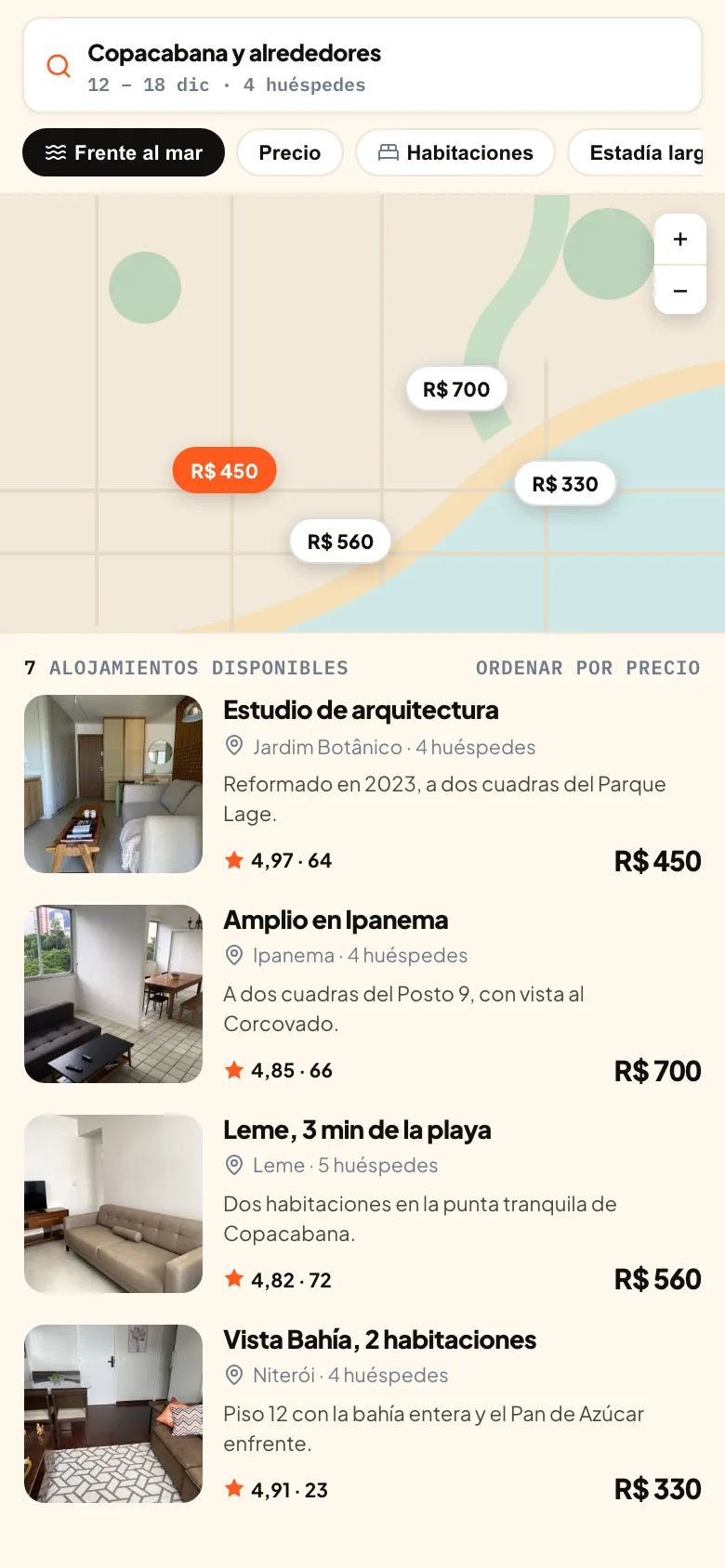
Results with a map

The guest compares neighbourhood and rate without opening a single listing. It's what today gets solved by sending links one by one.

  1. 1
    The price is the marker

    R$ 450 a night, right on the map. No pin to open to find out what it costs.

  2. 2
    Neighbourhood, rating and rate

    Each apartment says where it is, how it was rated and what a night costs.
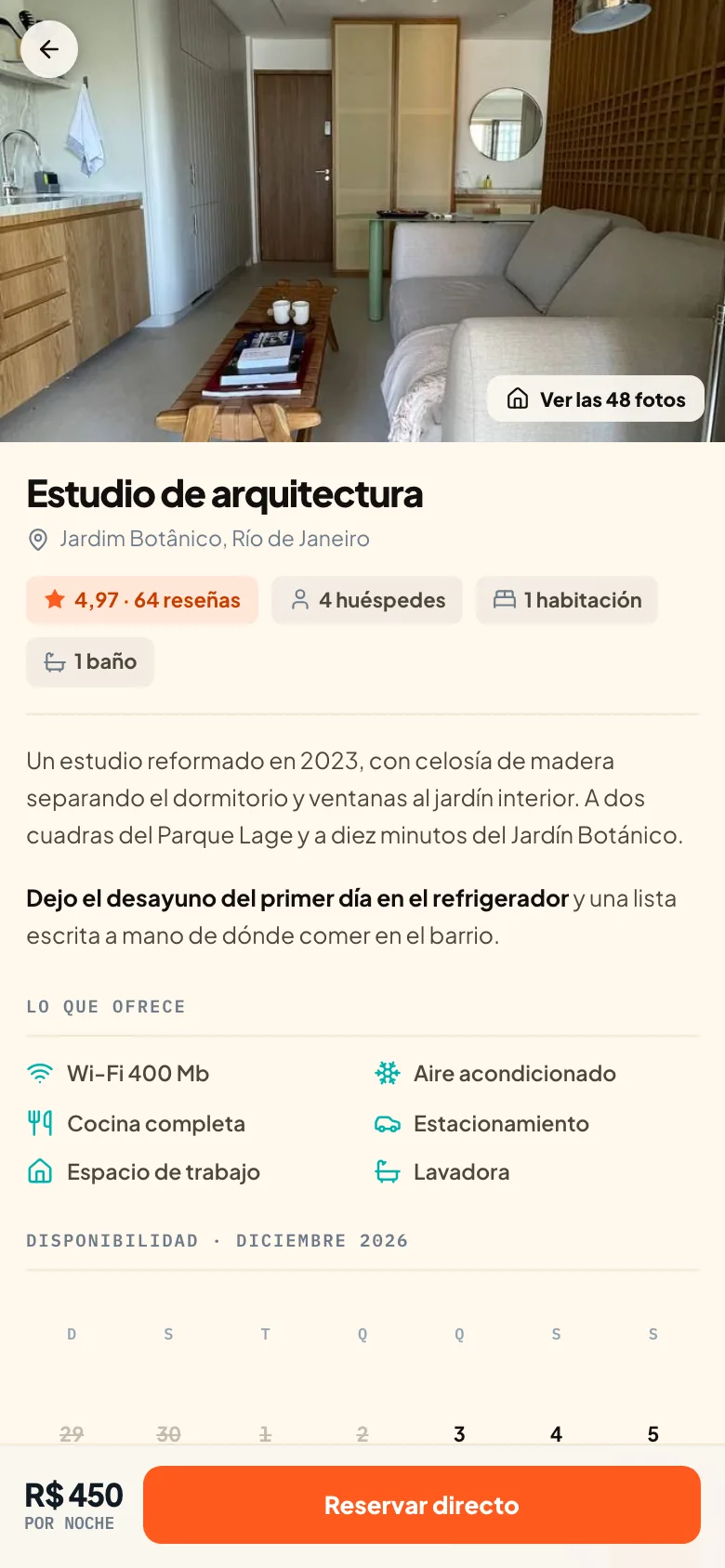
Listing page — An Airbnb co-host with twenty apartments in Rio de Janeiro

02

Listing page

The photo opens full width and the booking bar never leaves. Amenities and description come from the real listing.

  1. 1
    Book, always within reach

    Price per night and a single button, fixed at the bottom while you scroll.

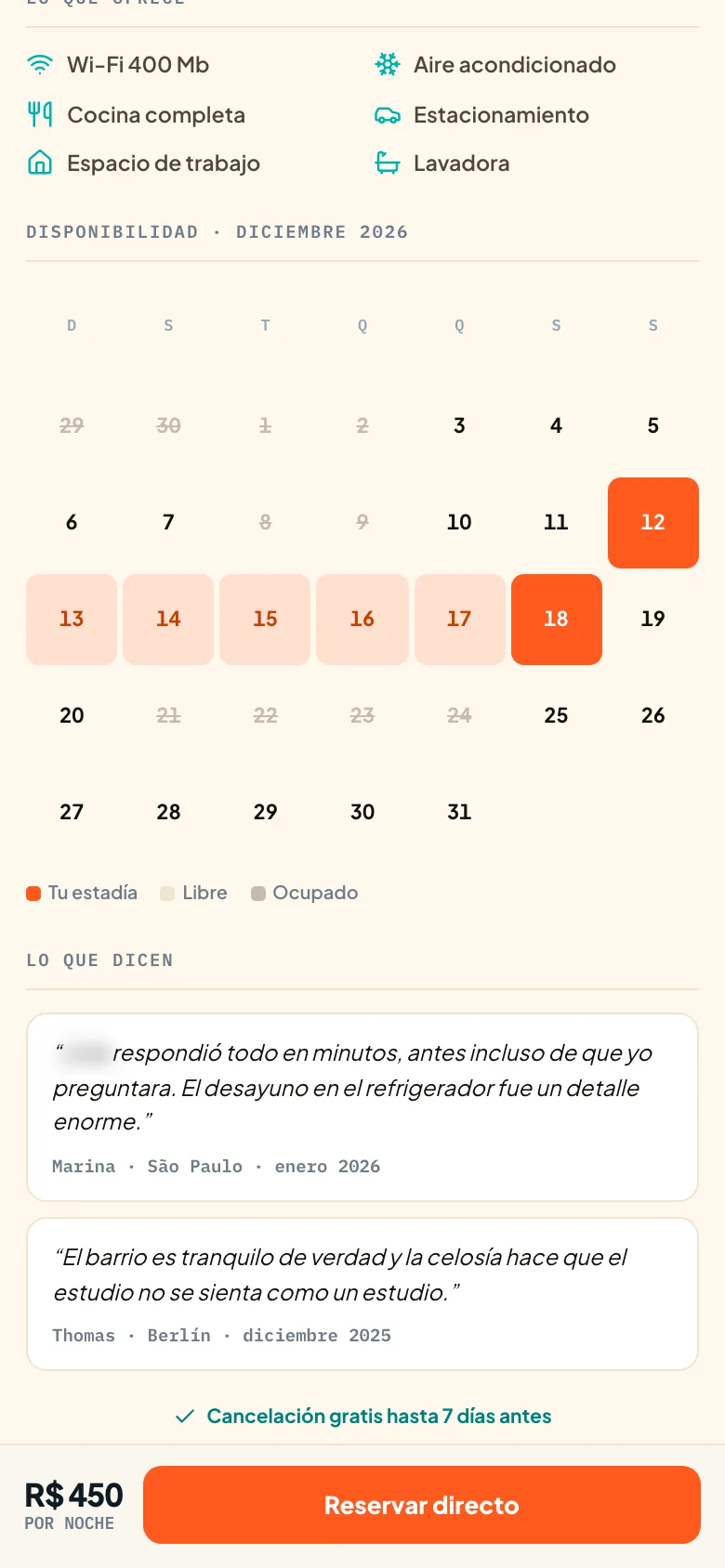
Live availability — An Airbnb co-host with twenty apartments in Rio de Janeiro

03

Live availability

The calendar is painted with what Stays says. If a night already sold on Airbnb, it shows as taken here.

  1. 1
    The stay, marked

    12 to 18 December. Booked nights are struck through, not hidden.

  2. 2
    Reviews as quotes

    Airbnb doesn't hand out its reviews through an API. They're transcribed once, chosen, with attribution.

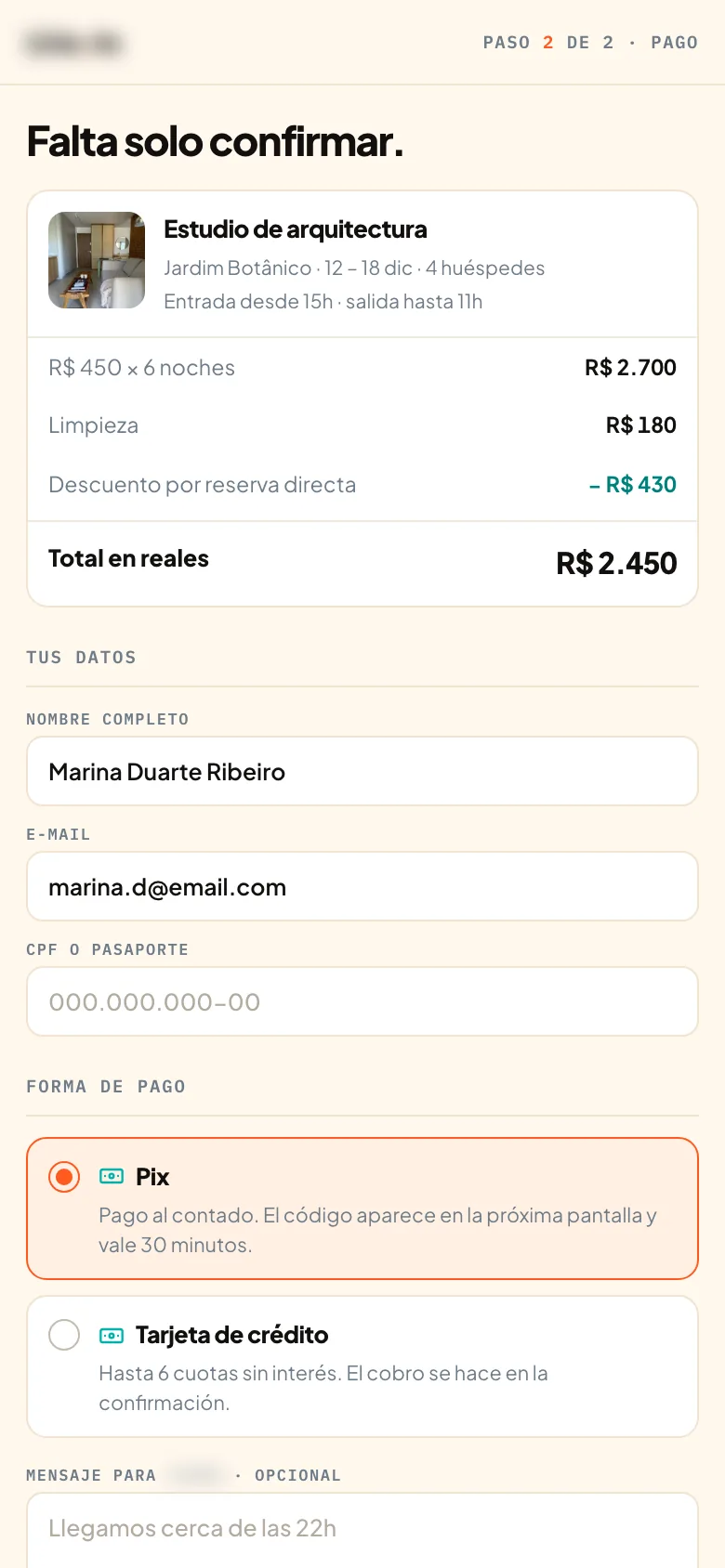
Payment — An Airbnb co-host with twenty apartments in Rio de Janeiro

04

Payment

The summary says what each thing costs, and the direct-booking discount gets its own line. It's the concrete reason not to go back to Airbnb.

  1. 1
    The discount is visible

    − R$ 430 for booking on her own site. Without that line, the guest has no reason to switch channels.

  2. 2
    Pix and card, on the same level

    The payment gateway is in the client's name. The money never goes through me.

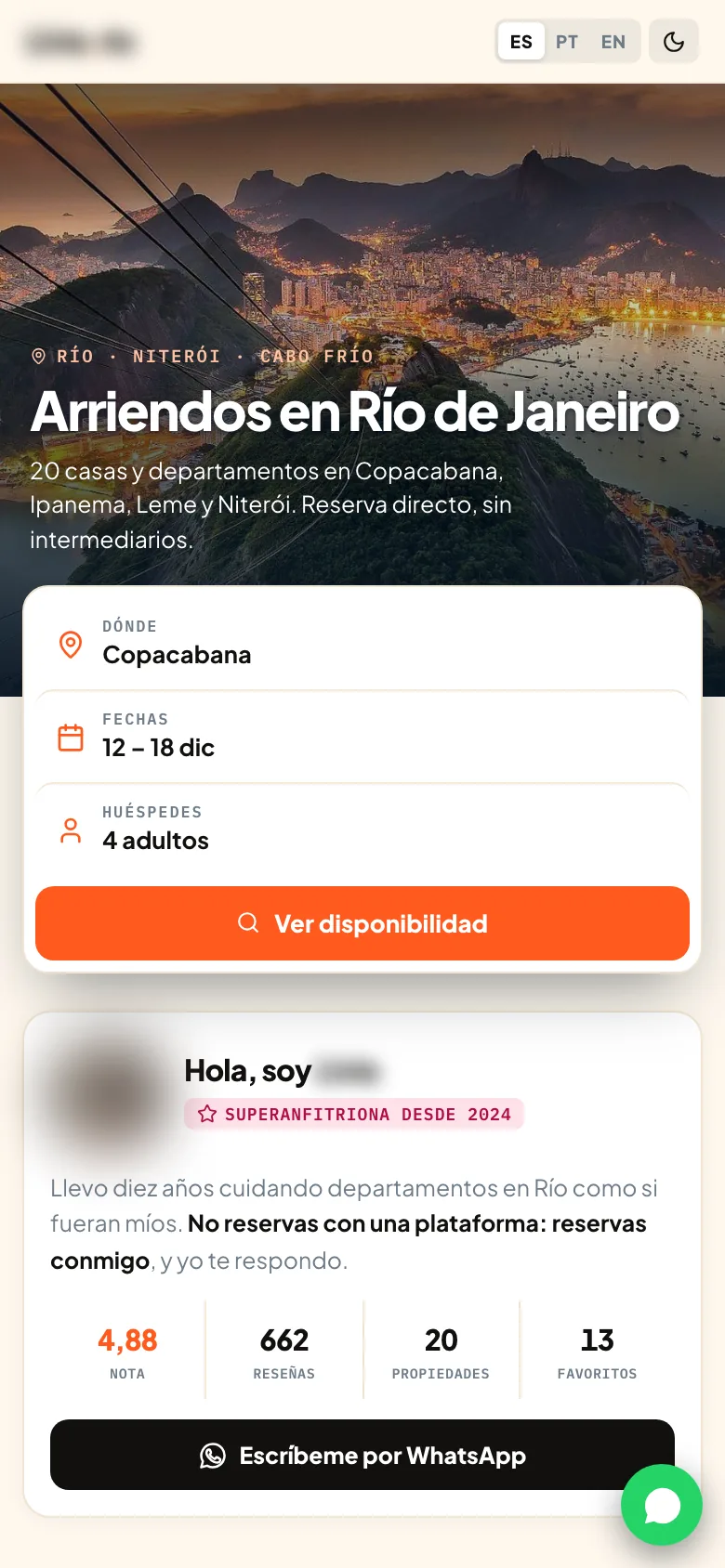
Homepage — An Airbnb co-host with twenty apartments in Rio de Janeiro

05

Homepage

The search is on the first screen. Below it the host speaks in the first person: you book with someone, not with a platform.

  1. 1
    Search without writing

    Where, when and how many: the three questions that get asked on WhatsApp today.

  2. 2
    Reputation, as data

    Rating, reviews, properties and favourites, taken from her public Airbnb profiles.

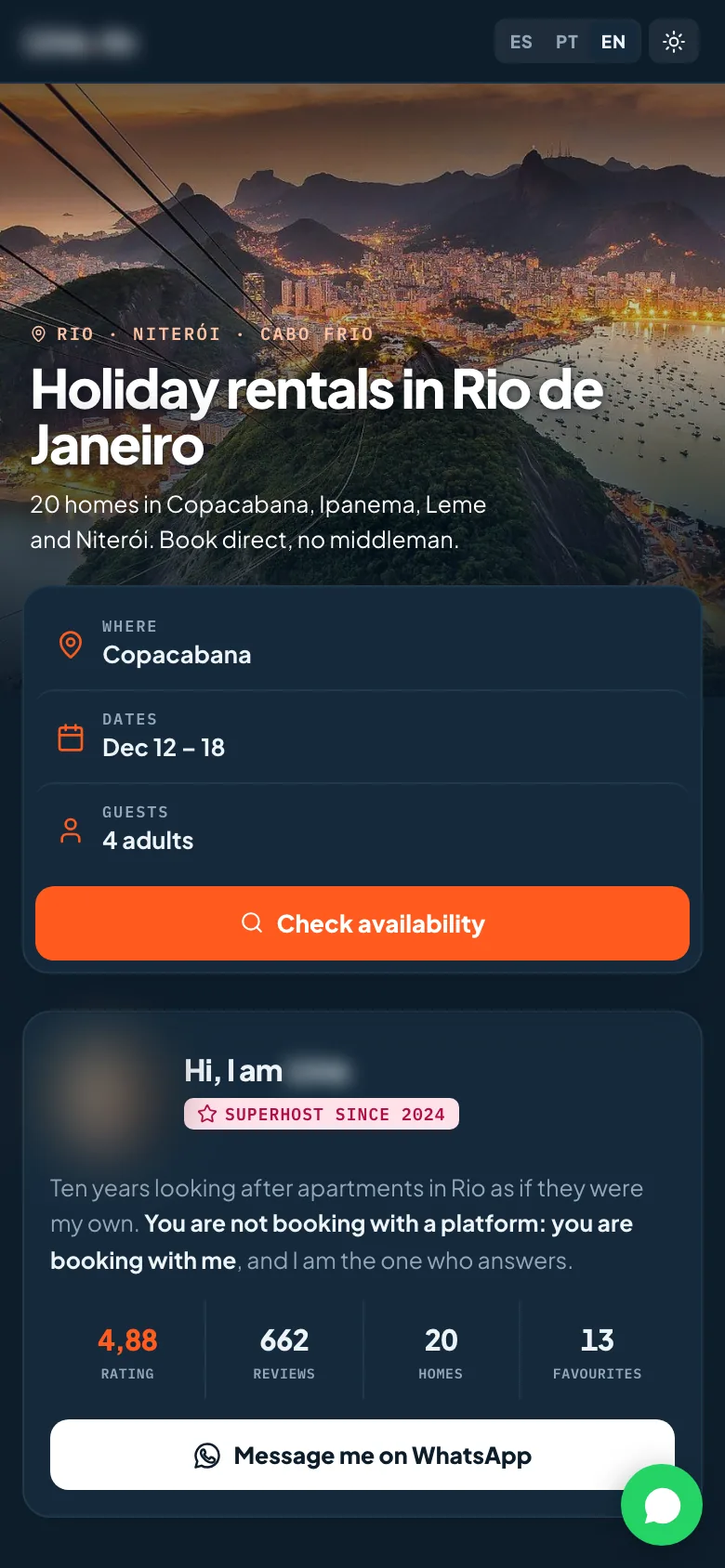
Three languages and dark mode — An Airbnb co-host with twenty apartments in Rio de Janeiro

06

Three languages and dark mode

Portuguese, Spanish and English, each with its own address, which is what lets Google find every version. Dark mode changes the colours, not the design.

  1. 1
    PT · ES · EN

    The language and dark-mode switches belong to the site, not to the prototype.

Owners page — An Airbnb co-host with twenty apartments in Rio de Janeiro

07

Owners page

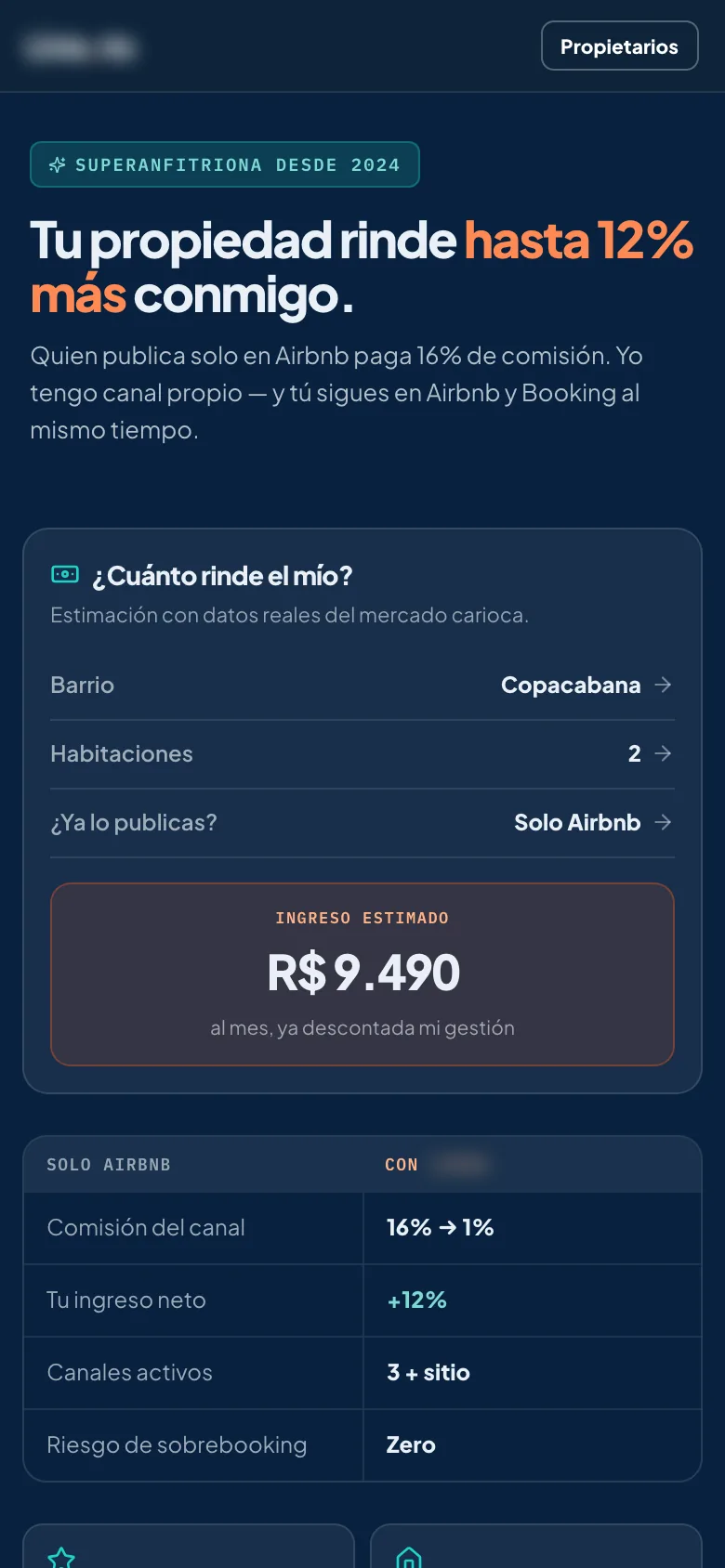
Every new apartment is income that repeats every month for the manager. The owner comes in to work out what theirs would earn and leaves their WhatsApp.

  1. 1
    The estimator is the hook

    Neighbourhood, bedrooms and where it's listed today. The estimate shows up before asking for any contact details.

WhatsApp assistant — An Airbnb co-host with twenty apartments in Rio de Janeiro

08

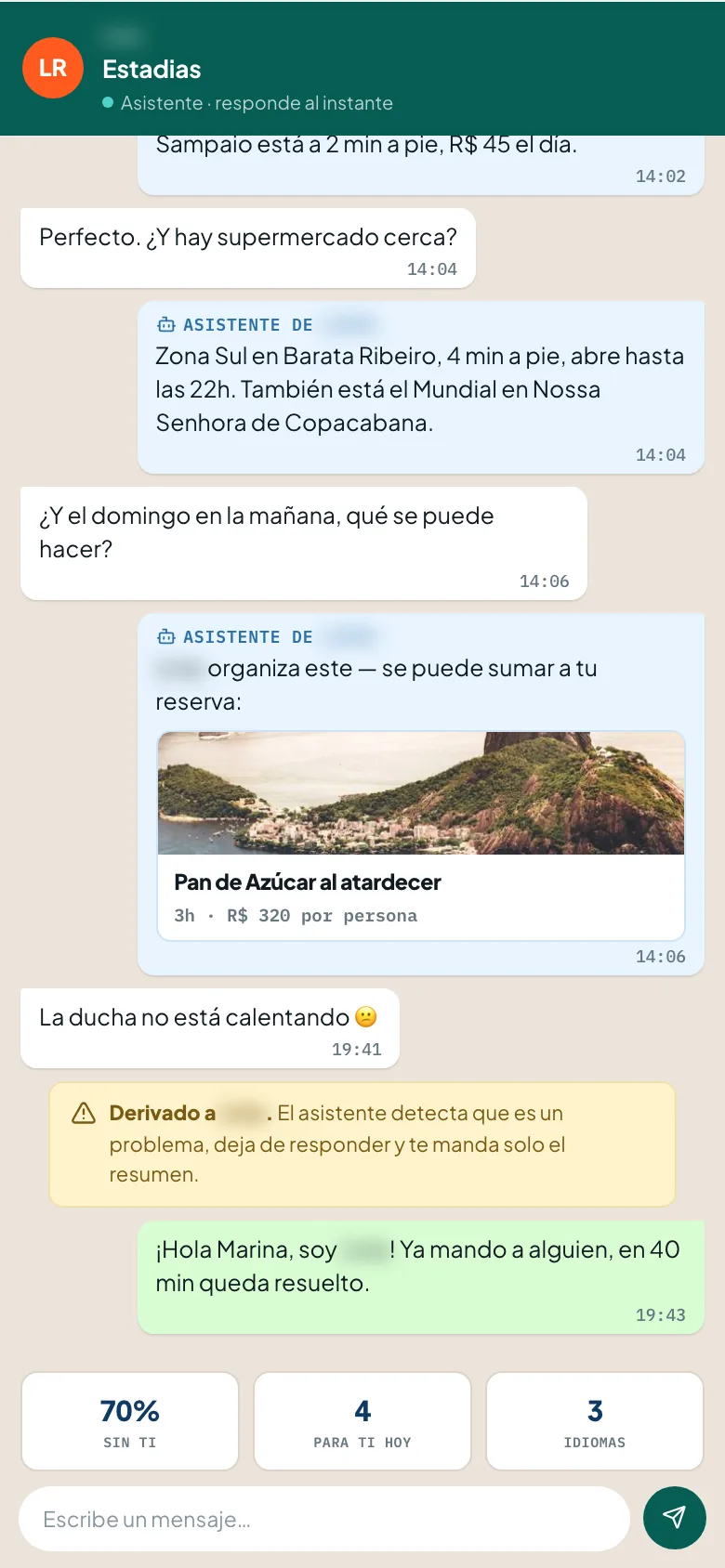
WhatsApp assistant

It answers what repeats —luggage, parking, supermarket— with neighbourhood notes written by the host. When something breaks, it stops answering and hands the case over.

  1. 1
    It knows when to stay quiet

    "The shower isn't heating" is not a frequent question: it goes straight to the host.

  • Search by dates, guests and neighbourhood, against StaysWhat it removes

    The WhatsApp back-and-forth to find out whether anything is free. The site asks Stays on every search and never offers a night that's already sold.

  • Results with a map, the price as the markerWhat it removes

    Sending Airbnb links one by one so the guest can compare.

  • Listing page with a live calendar and price by datesWhat it removes

    Working out by hand what a stay costs.

  • Booking and payment on the site, with Pix and cardWhat it removes

    Airbnb's 16% on bookings the host lands on her own. The direct-booking discount sits on its own visible line in the summary.

  • Portuguese, Spanish and English, with dark modeWhat it removes

    Serving a foreign guest by translating message after message. Each language has its own address, and Google finds each version.

  • Owners page with an estimatorWhat it removes

    An owner having to write to find out whether it's worth it. It works out what their apartment would earn and leaves their WhatsApp.

  • Experiences catalogueWhat it removes

    Looking for a guide every time a guest asks what to do. The tour is requested with the booking and the host confirms it.

  • Guest assistant, on WhatsApp and on the siteWhat it removes

    Answering ten times a day where the supermarket is. The delicate stuff —complaints, emergencies— it doesn't answer: it hands it to her with a summary.

What happens on its own

  • The booking is created in Stays through the API, and Stays passes it to Airbnb and Booking: one calendar for every channel.
  • Confirmation email to the guest and a WhatsApp alert to the host as soon as a booking comes in.
  • Photos, copy and amenities for each property are edited once in Stays and change on Airbnb, Booking and the site.
  • Every interested owner arrives by email and WhatsApp with their neighbourhood and number of bedrooms.

What changed?

What changed.

It's a proposal. The clickable design has been published since September 2026 and the client hasn't approved it yet, so there is no operation to measure and no result to report.

  • The dates, people and neighbourhood question stops being answered by hand: the site answers it against the real calendar.
  • A direct booking pays the payment gateway instead of the 16% Airbnb charges hosts in Brazil.
  • An apartment owner has somewhere to size her up before writing.
  • Guests, owners and cleaning stop sharing one WhatsApp: owners see their numbers in the Stays portal, cleaning moves to its task module and the assistant keeps the guests.

Measured on the system

I measured these on the code and the live site. They can be checked again.

  • 3languages with their own switch: Portuguese, Spanish and English
  • 4screens from search to payment
  • 20real properties loaded into the design, with their public data
  • 0nights stored on the site: availability is read from Stays

What is still missing

Everything depends on the Stays API credentials, which its support team issues and which depend on neither the client nor me. The screenshots are from the design published in September 2026; the brand name and the client's photo are blurred because there is no permission to show them.

Why it is built this way
Platform
Next.js on Vercel. Routes per language (/pt, /es, /en) and server rendering are what get a listing page onto Google, which is the channel Airbnb doesn't give you.
Bookings
The Stays API —search, calendar, prices and checkout— is called from the server, so the credentials never reach the browser.
Own data
A small database: copy, translations, chosen reviews and owner leads. It stores no bookings and no availability.
Payment
Stays checkout, with Pix and card, and the gateway in the client's name. No payment integration of our own in the first version.
Prototype
The clickable design is static HTML: the phones scroll with your finger and the language switch and dark mode really work.

The full case is also written in Spanish. Leer el caso en español →

Free meeting · 30 minutes

Want to know what we could do for your business?

Book a free meeting. We look at how you work today, together, and I help you work out what’s worth digitising first, and why.

  • ✓ Online or at your business
  • ✓ You leave knowing where to start
  • ✓ No strings attached
Book my free meeting →